
Fuel stations & petroleum

Petrol station management software that finds the litres before they disappear

Covadesk reconciles every tank every day, checks every pump price against the EPRA cap for the current cycle, and cashes up every attendant’s shift against the meters — then posts it all to the same ledger as your shop, payroll and suppliers.

Built for: Independent forecourts, dealer-operated and multi-site station networks, and petroleum distributors running depots and retail sites in Kenya.

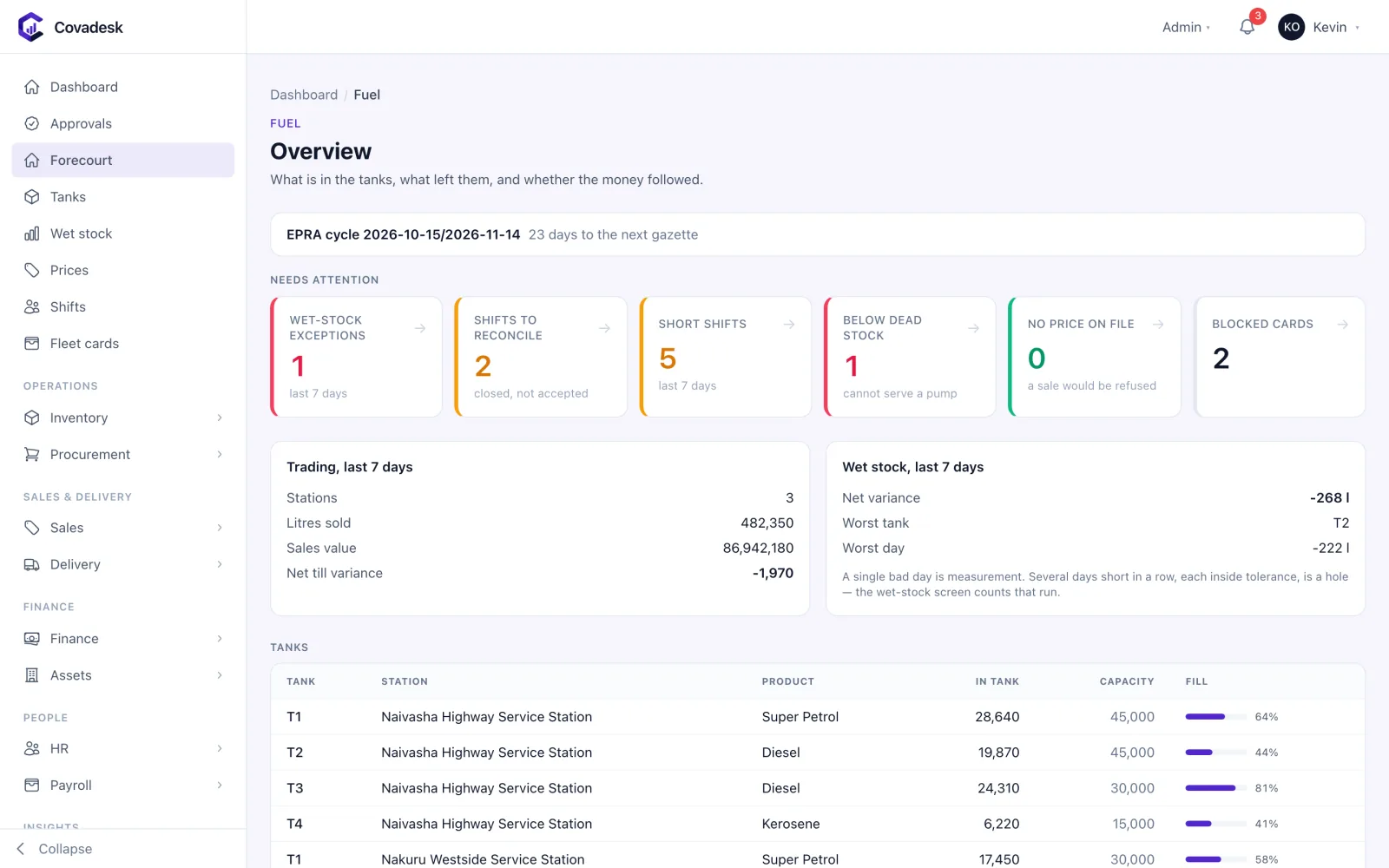
Covadesk fuel station dashboard with wet-stock exceptions, shift reconciliation and tank levels

The problems we solve

Where fuel stations lose money — and how Covadesk closes the gap

  • Theft hides inside tolerance

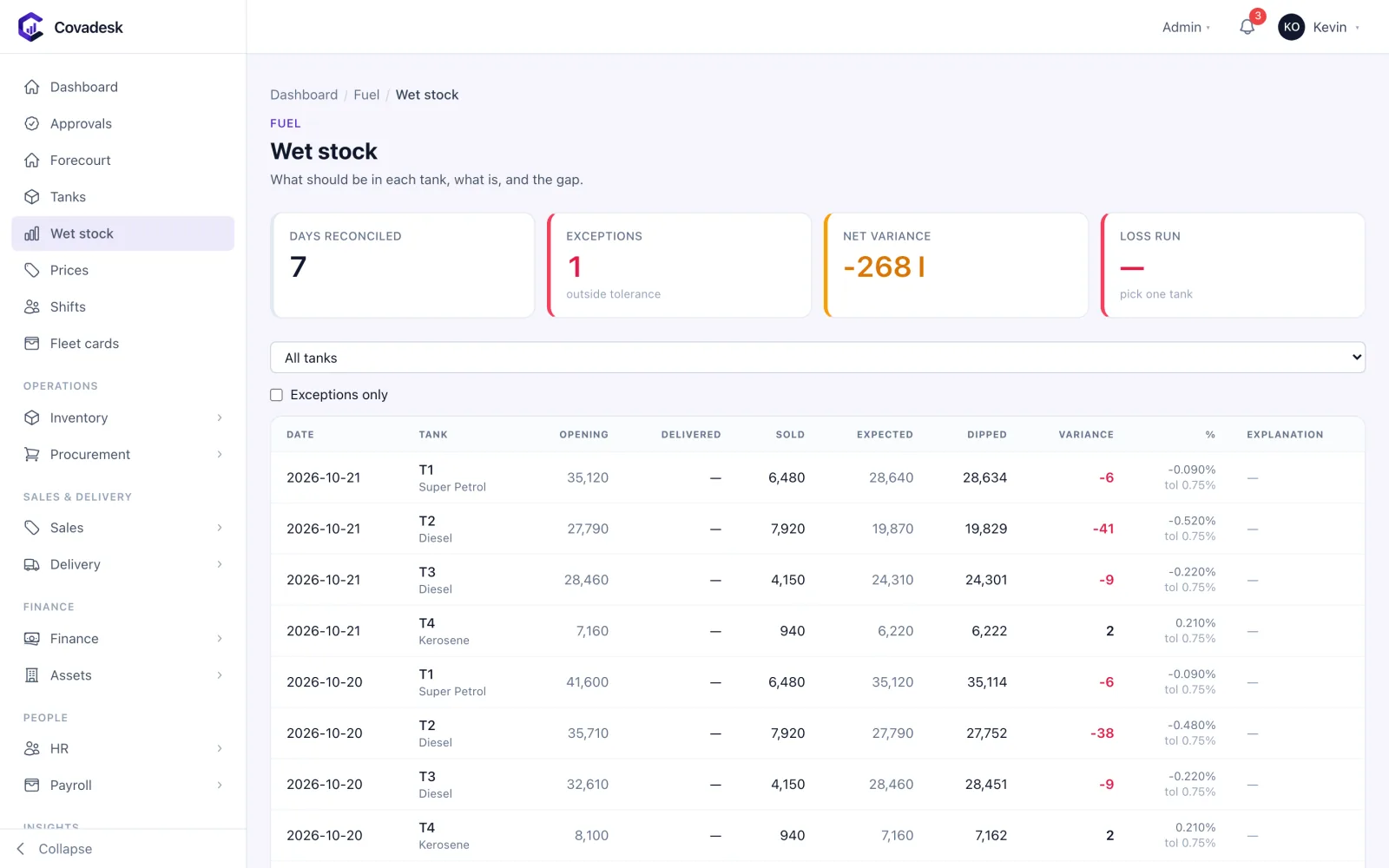
    Fuel loss rarely shows as one bad day. It shows as a run of small negative variances in the same direction. Covadesk stores the reconciliation per tank per day, with the tolerance that judged it, so the pattern is visible.

  • Pump prices above the cap

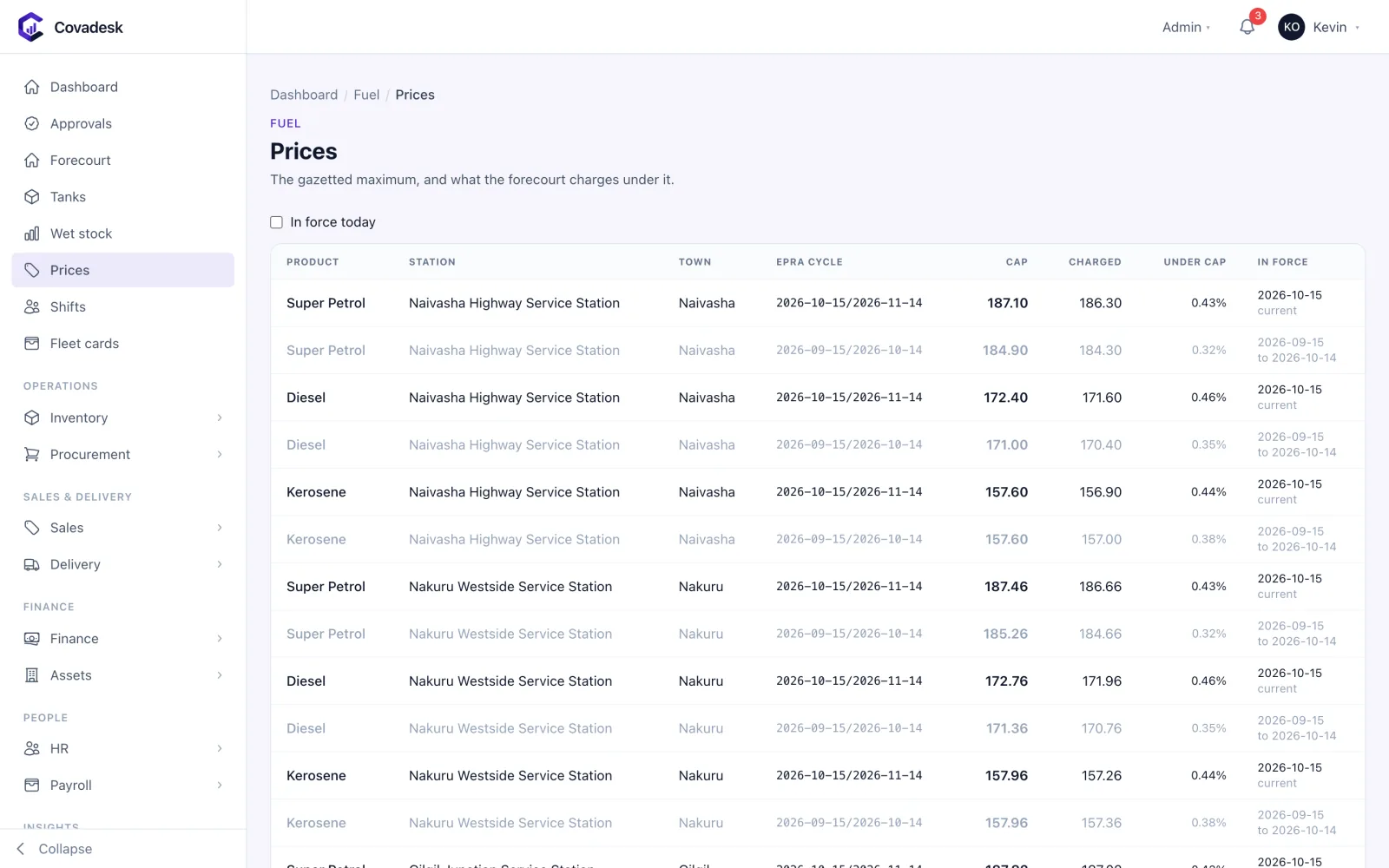
    EPRA gazettes maximum prices for a cycle that runs from the 15th to the 14th — not the calendar month. A price above the cap is refused before a sale is made at it.

  • Shifts that never quite balance

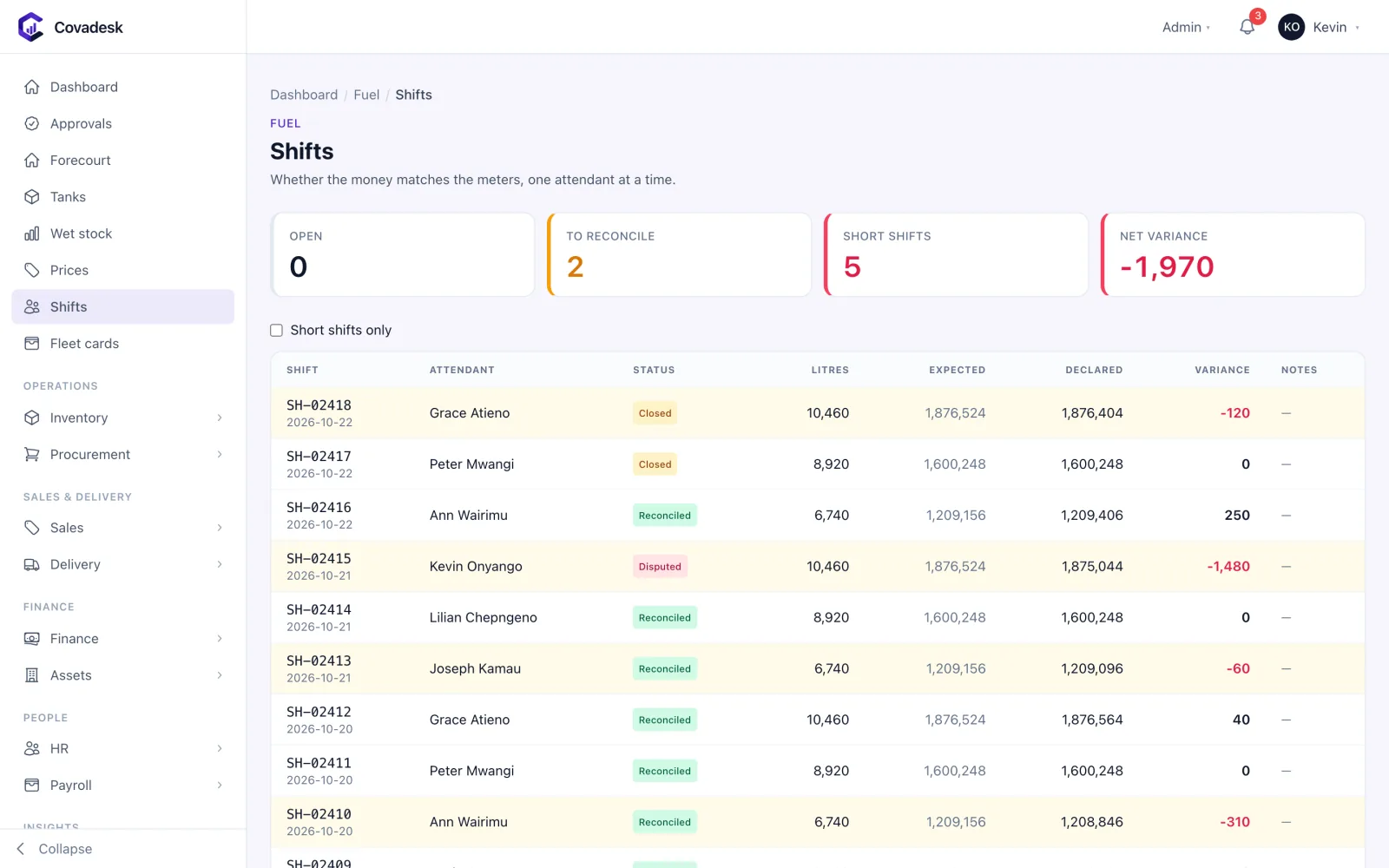
    Meters, cash, M-Pesa and card takings are declared per attendant per shift, so a short shift has a name and a number on it the same day.

  • Fleet customers on paper vouchers

    Fuel cards with limits and blocking replace vouchers, and every fill posts to the customer’s account.

See it in action

What fuel stations see in Covadesk

Real Covadesk screens, shown with sample data.

Covadesk fuel station dashboard with wet-stock exceptions, shift reconciliation and tank levels

What is in the tanks, what left them, and whether the money followed — with the EPRA cycle on top.

Features

Everything fuel stations need, in one system

Daily wet-stock reconciliation

Opening stock, deliveries, litres sold from the meters and the closing dip — reconciled per tank, per day.

  • Expected versus dipped stock with litre and percentage variance
  • Tolerance stored with each day so a later policy change cannot rewrite history
  • Loss runs flagged — consecutive short days on the same tank
  • Exceptions-only view for the station manager

EPRA price cycles

Pump prices are set per product per station and checked against the gazetted maximum for the cycle.

  • Cycle runs 15th to 14th, matching the EPRA gazette
  • Price above the cap refused at entry
  • Days to the next gazette shown on the dashboard
  • Full price history per station and product

Attendant shifts and cash-up

Each attendant’s shift opens on meter readings and closes on what they declare.

  • Opening and closing meter readings per pump
  • Expected takings computed from litres and price
  • Cash, M-Pesa and card declared, with the shortage or excess
  • Shift accepted by a supervisor with an explanation for any variance

Tanks and deliveries

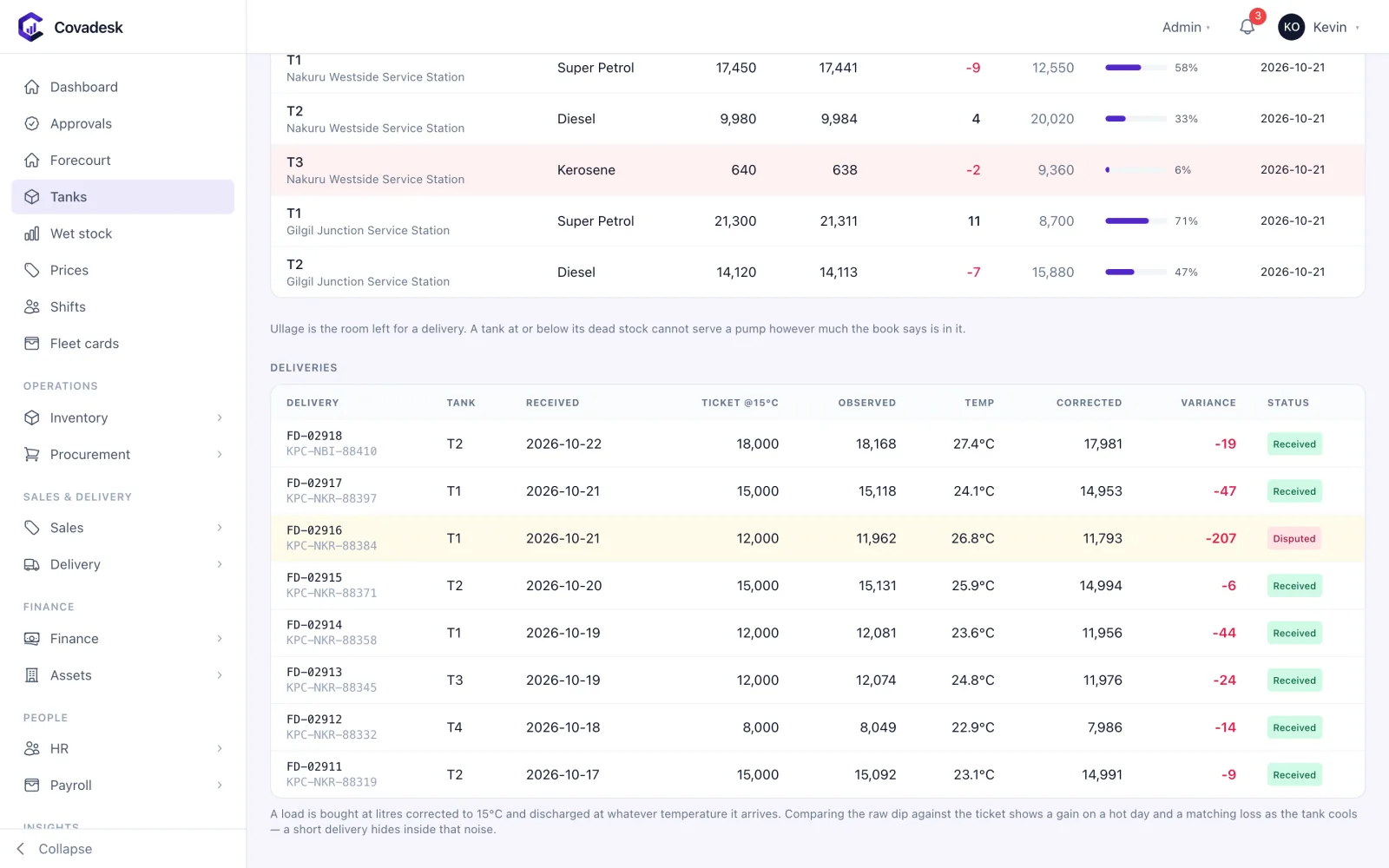
The tank register shows what is in every tank and what can still be sold.

  • Fill level and capacity per tank
  • Dead-stock level — below it, the pump cannot serve
  • Deliveries received against purchase orders and posted to stock

Fuel cards and the shop

Fleet accounts and the convenience store run on the same customer and stock records.

  • Fuel cards with limits; blocked cards refused at the pump
  • Convenience store stock, POS and supplier ordering through the core modules
  • KRA eTIMS invoices from every sale

How it flows

One process, start to finish

  1. 01

    Set the cycle price

    Enter pump prices for the EPRA cycle; anything above the cap is refused.

  2. 02

    Open shifts

    Attendants start on recorded meter readings.

  3. 03

    Sell

    Litres, cash, M-Pesa, card and fuel-card fills are captured.

  4. 04

    Cash up

    Shifts close on declared takings; variances are explained and accepted.

  5. 05

    Dip and reconcile

    Daily dips reconcile each tank against deliveries and meters.

  6. 06

    Post

    Sales, stock and variances post to the general ledger automatically.

Modules included

The Fuel Stations & Petroleum pack

Forecourt retail with wet-stock and convenience store.

Industry modules for fuel stations

Switched on by the pack from day one, on top of the backbone below.

  • Fuel Stations & Petroleum

    Operations

    Wet stock, pumps and shifts reconciled every day

    • Tank register with fill level, capacity and dead stock
    • Daily wet-stock reconciliation — opening, deliveries, sales, dips, variance
    • EPRA price cycles with pump prices checked against the cap
    • Attendant shifts with meter readings, cash and M-Pesa declared
    • Fuel cards for fleet customers with limits and blocking

The backbone every Covadesk business runs on

The same core modules run across every industry, so purchasing, stock, sales, accounts and people share one database and one version of the truth.

  • Procurement

    Operations

    Buy with control, from requisition to supplier payment

    • Purchase requisitions routed for approval by value, branch and role
    • Requests for quotation with side-by-side supplier comparison and award
    • Purchase orders that inherit item VAT rates and approved prices
    • Goods received notes with QA tolerance bands for weight, moisture and grade
    • Three-way match of PO, GRN and supplier invoice before anything is paid
    • Supplier advances tracked and recovered against later invoices
    • Supplier register with categories, terms and performance history
  • Inventory

    Operations

    One stock figure that finance and the store agree on

    • Multi-warehouse stock levels, by item, location and batch
    • Batch and expiry tracking with QA holds that block issue until released
    • Inter-branch and inter-warehouse transfers with in-transit stock
    • Stock takes with variance approval and automatic write-off postings
    • Reorder levels per warehouse and full movement history per item
    • Stock ageing and valuation reports that tie to the general ledger
    • Units of measure with conversions — buy in bags, sell in kilos
  • Sales

    Commercial

    Quote, sell, invoice and collect in one flow

    • Quotations that convert to sales orders, delivery notes and invoices
    • Counter POS and counter sales with cash, M-Pesa, card and voucher tenders
    • Price lists and customer categories with credit limits enforced at order time
    • Credit notes, returns and receipts — including refunds on the receipt
    • AR ageing, dunning and credit-override approvals with an audit trail
    • Van sales with load-out, field selling and end-of-day reconciliation
    • Sales commissions and a sales register by channel and period
  • Finance & Accounting

    Finance

    A general ledger every module posts into as it happens

    • Chart of accounts, accounting periods and period close
    • Journals with approval, plus automatic postings from every module
    • Bank accounts, statement import and bank reconciliation
    • Supplier payments, petty cash and AP ageing
    • VAT and withholding tax computed at the transaction line, with returns data
    • Budgets by account and cost centre, with budget-versus-actual
    • Trial balance, profit and loss, balance sheet and cash flow on demand
  • Human Resources

    People

    Your people, their records and their requests in one place

    • Employee records with contracts and organisation structure
    • Leave policies, balances, requests and approvals — with self-service
    • Attendance capture and shift rosters
    • Appraisals and disciplinary cases with a recorded outcome
    • An HR service desk for employee requests
  • Payroll

    People

    Kenyan payroll that is right the first time

    • Pay runs with maker-checker approval before release
    • PAYE on current KRA bands with personal relief
    • NSSF, SHIF and Affordable Housing Levy calculated per employee
    • Salary structures, allowances, deductions and staff loans
    • Statutory return files and payslips generated from the same run
    • Payroll journals posted straight to the general ledger
  • Fixed Assets

    Finance

    A fixed asset register your auditor will sign

    • Asset register by category, location and custodian
    • Scheduled depreciation posted to the ledger
    • Disposals with gain or loss calculated and booked
    • Transfers between branches with history
  • Delivery & Fleet

    Operations

    Get orders out of the gate and onto the road

    • Dispatch runs that load delivery notes onto a vehicle and driver
    • Vehicle and driver registers with documents and expiry dates
    • Delivery routes and run status from loading to complete
    • Fuel issues and vehicle maintenance logged per vehicle
  • Reports & Analytics

    Insights

    Answers across every module, without exporting to Excel

    • Executive dashboard with cash, sales, stock, output and receivables
    • Ready-made payroll, HR, sales, stock and finance reports
    • Saved reports, with exports to CSV, Excel and PDF
  • Integrations

    Settings

    Connected to the systems Kenyan businesses depend on

    • KRA eTIMS invoice and credit-note transmission with retry and a send log
    • M-Pesa C2B, STK Push and B2C through Daraja, matched to customer accounts
    • SMS and email notifications
    • Webhooks and API keys for your own systems

Add more when you need it

Any other module can be switched on for your organisation — same data, nothing to re-implement.

  • CRM
  • Projects & Job Costing
  • Warehouse Management
  • Manufacturing (Work Orders & MRP)
  • Quality Management (QMS/LIMS)
  • Maintenance (CMMS)
  • Contract Management
  • Documents
  • Customer & Supplier Portals
  • Helpdesk / Service
  • BI & Workflow Builder
  • Production (Batch/Process)
  • DigiSales (Field Sales)
  • Milling Intake & Weighbridge
  • Construction & Contracting
  • Real Estate & Property
  • SACCO / Microfinance
  • Logistics / 3PL
  • Agriculture & Agribusiness
  • Automotive Workshops
  • Professional Services
  • NGO / Donor-Funded
  • Hospitality

Compliance

Kenyan rules, built in

EPRA price cap
Pump prices validated against the gazetted maximum for the current cycle.
KRA eTIMS
Tax invoices transmitted to eTIMS with retry and a send log.
M-Pesa
Till and paybill receipts matched to shifts and customer accounts.
Payroll statutory
Attendant payroll with PAYE, NSSF, SHIF and Housing Levy.

Questions

Covadesk for fuel stations: common questions

How does Covadesk detect fuel loss?

Every tank is reconciled every day: opening stock plus deliveries minus litres sold from the meters gives expected stock, which is compared with the physical dip. The variance and the tolerance that judged it are stored per tank per day, and runs of consecutive short days are flagged — the pattern that a monthly total hides.

Does Covadesk enforce EPRA maximum pump prices?

Yes. Prices are recorded per product per station for each EPRA cycle, which runs from the 15th of one month to the 14th of the next. A pump price above the gazetted maximum for that cycle is refused.

Can Covadesk run several stations?

Yes. Stations are branches, so each has its own tanks, prices, shifts and reconciliation, and group reports roll them up.

Does it handle the convenience store too?

Yes. The shop runs on Covadesk’s inventory, POS, purchasing and finance modules, so forecourt and shop share one set of books.

See Covadesk running for fuel stations

Book a 30-minute demo. Bring a real problem — a stock variance you can’t explain, a payroll run that takes three days — and we’ll show you how it works in Covadesk.

Prefer to talk? Call +254 117 390 922 or email info@fecn.co.ke