
NGO & non-profit

NGO accounting software where restricted funds cannot be overspent

A donor gives for a purpose, and spending that money on anything else is the audit finding that ends a grant. Covadesk models restricted funds that refuse overspend, schedules every donor report when the grant is awarded, allocates shared costs by approved rules and keeps a deduplicated beneficiary registry.

Built for: International and local NGOs, community-based organisations, foundations and faith-based organisations managing donor-funded programmes.

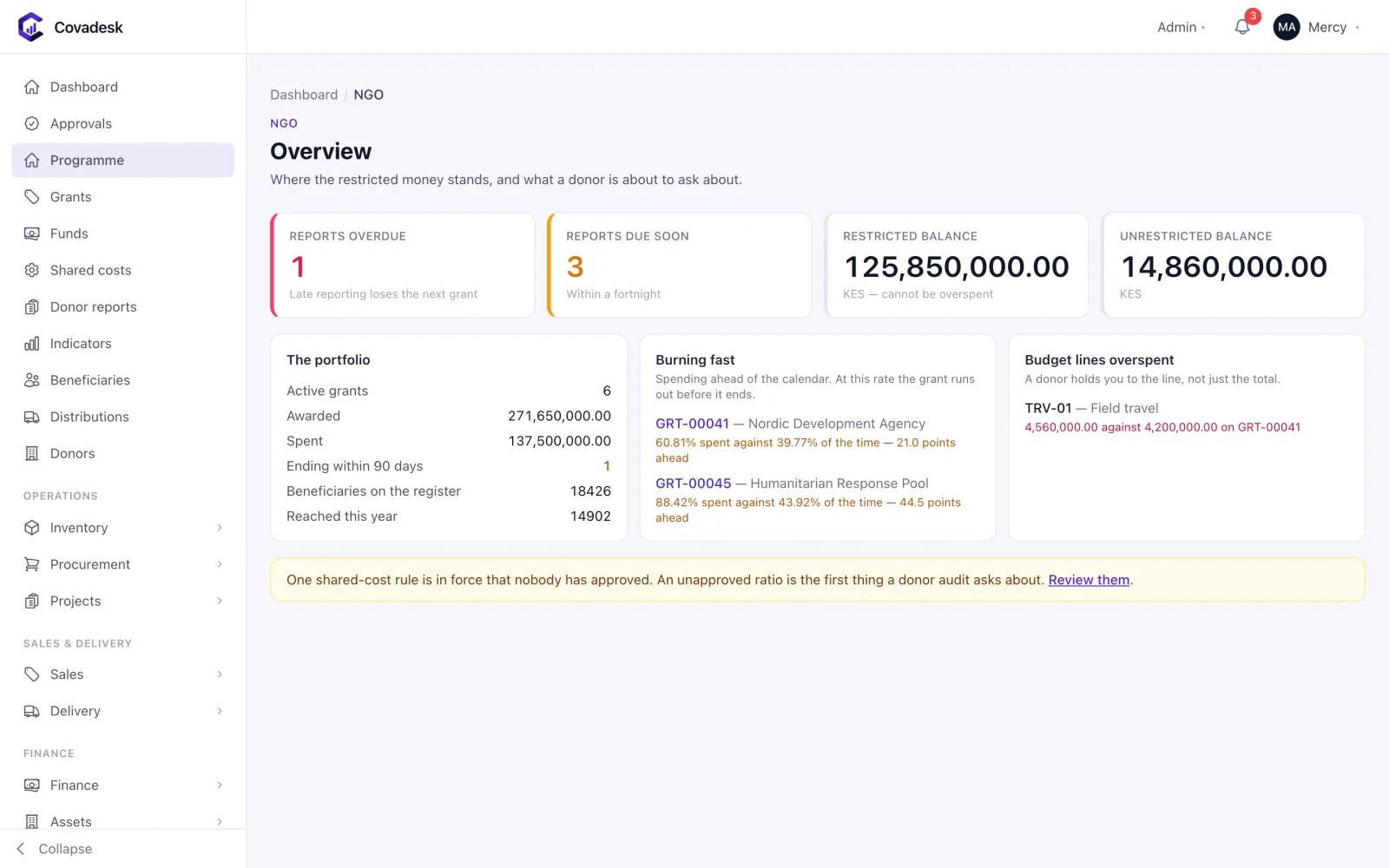
Covadesk NGO dashboard with restricted and unrestricted balances, overdue reports and grants burning fast

The problems we solve

Where NGOs lose money — and how Covadesk closes the gap

  • Overspend discovered after the fact

    A cost centre accepts every posting and reports the overspend afterwards. A Covadesk fund refuses it — commitments and spend both count against what is available.

  • Late donor reports

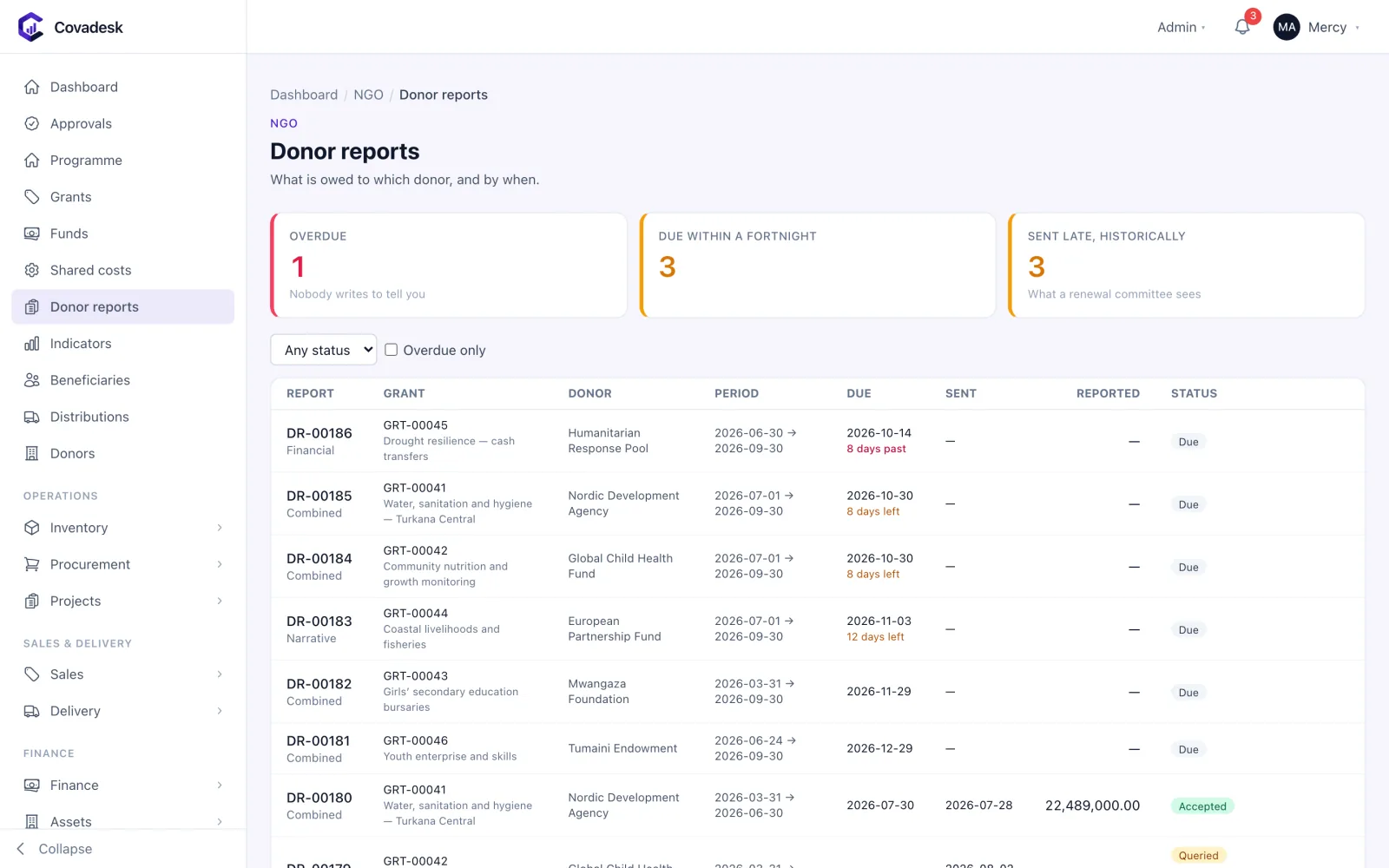
    Nobody writes to say a report was late; the renewal simply doesn’t come. Covadesk generates the reporting schedule for the whole grant at award.

  • Shared costs nobody can defend

    Rent, salaries and vehicles shared across grants are allocated by approved rules with a record of who approved them.

  • The same beneficiary registered twice

    Identifying numbers are hashed and unique, with soft matching on name, birth date and location — double-dipping is caught at registration.

See it in action

What NGOs see in Covadesk

Real Covadesk screens, shown with sample data.

Covadesk NGO dashboard with restricted and unrestricted balances, overdue reports and grants burning fast

Where the restricted money stands, and what a donor is about to ask about.

Features

Everything NGOs need, in one system

Grants and donors

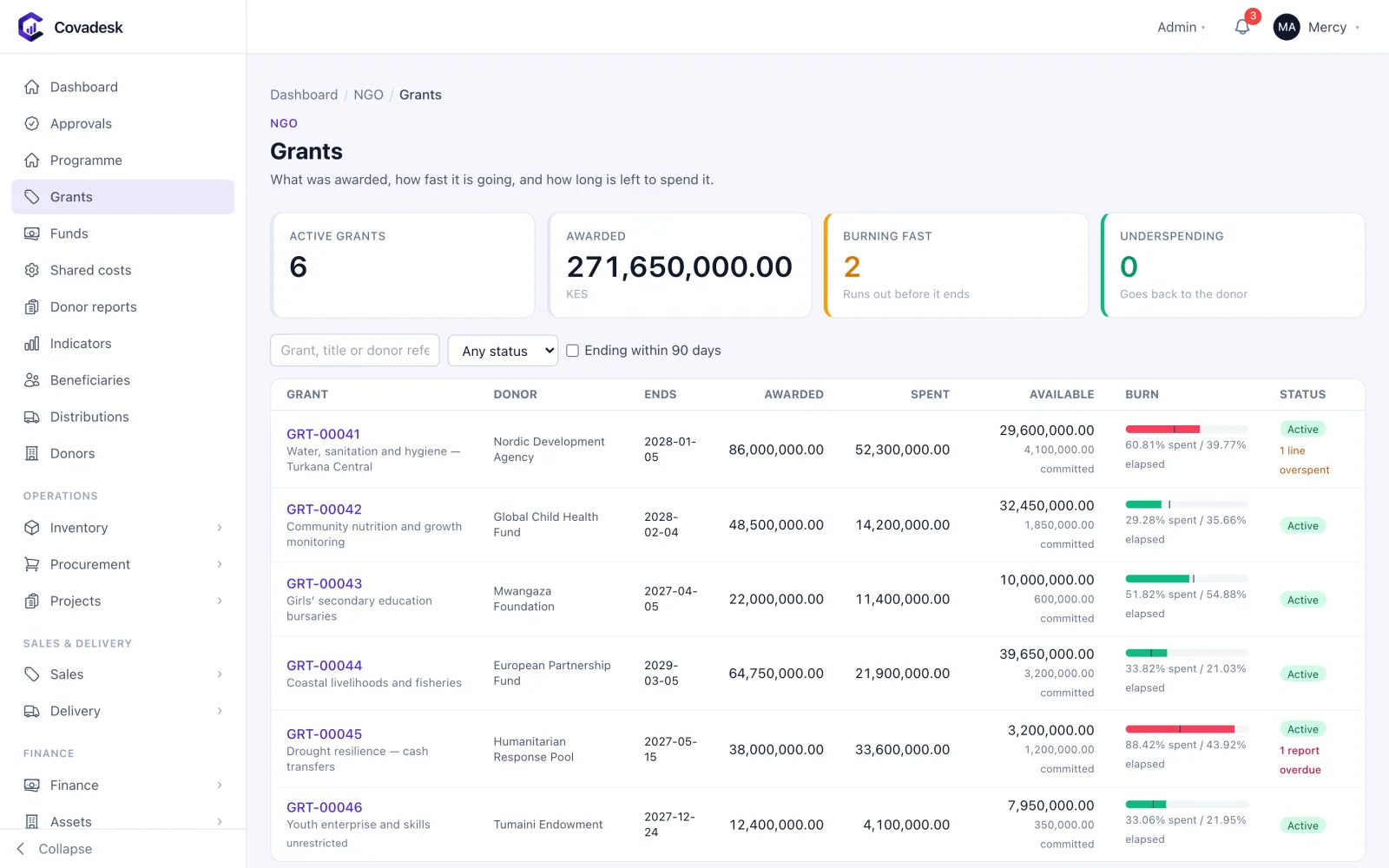
What was awarded, how fast it is going, and how long is left.

  • Grant register with donor, award, received, spent and end date
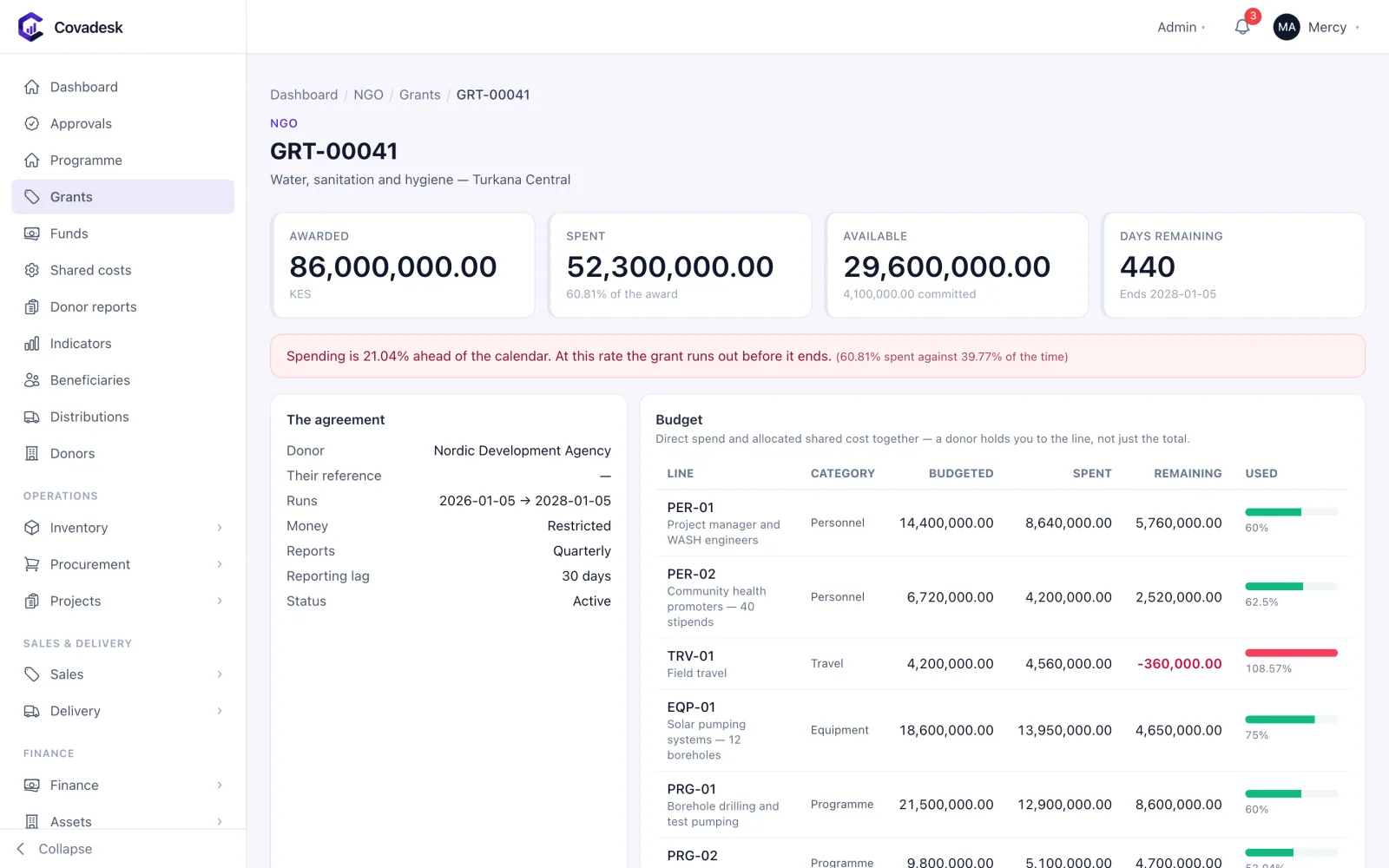
  • Burn rate against time elapsed, with grants burning too fast or too slowly flagged
  • Grants ending within 90 days
  • Donor register with history

Restricted fund accounting

Money held for a purpose, enforced by the ledger.

  • Restricted and unrestricted funds with available balance
  • Commitments tracked apart from spend — a PO reduces what can be committed again
  • Postings that would overspend a restricted fund are refused
  • Budget lines overspent surfaced on the dashboard

Shared-cost allocation

Auditable rules for costs that serve more than one grant.

  • Allocation rules that split a shared cost across grants
  • Rules approved before they take effect
  • Allocation journals posted with a trail back to the rule

Donor reporting and M&E

Financial and programme reporting from the same records.

  • Reporting schedule generated at award, with overdue and due-soon reports
  • Financial reports from the ledger, by grant and budget line
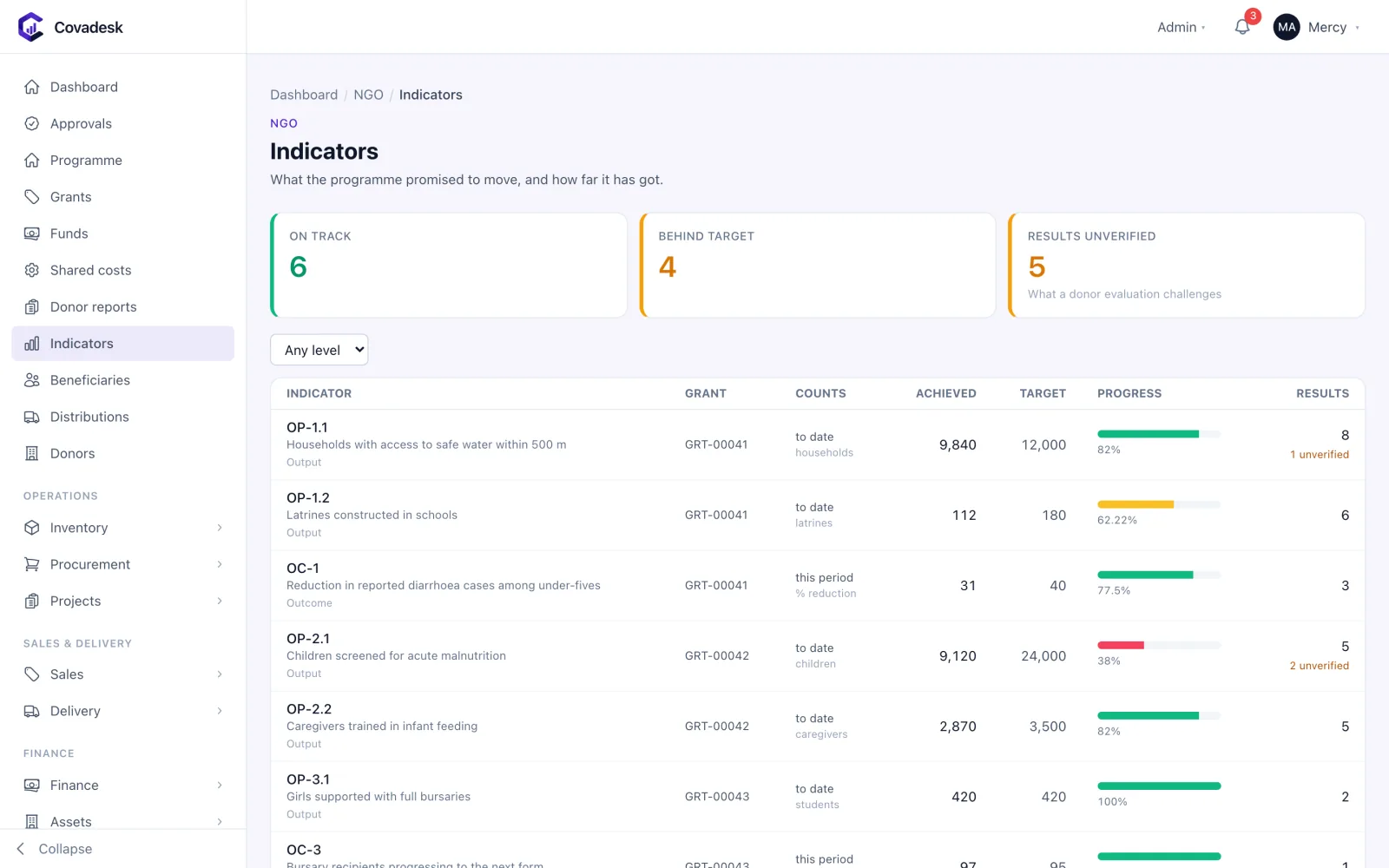
  • Indicators with targets and results, and progress against target

Beneficiaries and distributions

Who was reached, without counting anyone twice.

  • Beneficiary registry with hashed identification numbers
  • Duplicate detection by ID and by name, birth date and location
  • Distributions recorded per beneficiary

How it flows

One process, start to finish

  1. 01

    Award

    Record the grant, budget lines and reporting schedule.

  2. 02

    Fund

    Receipts land in the restricted fund they belong to.

  3. 03

    Spend

    Purchases and payments are checked against the fund before posting.

  4. 04

    Allocate

    Shared costs are allocated by approved rules.

  5. 05

    Deliver

    Register beneficiaries, record distributions and indicator results.

  6. 06

    Report

    Donor reports come from the ledger, on schedule.

Modules included

The NGO / Non-Profit pack

Donor-funded organisations — fund/grant accounting, beneficiaries, M&E.

Industry modules for NGOs

Switched on by the pack from day one, on top of the backbone below.

  • Projects & Job Costing

    Operations

    Know what every job costs while it is still running

    • Projects with budgets, cost codes and work breakdown
    • Timesheets costed at labour rates
    • Job costing from purchases, stock issues and labour
    • Progress billing tied to the project
  • NGO / Donor-Funded

    Finance

    Restricted funds that cannot be overspent

    • Grants with donor, award, burn rate and end date
    • Restricted and unrestricted funds with available balance
    • Auditable shared-cost allocation rules with approval
    • Donor reports from the ledger, not a spreadsheet
    • Indicators with targets and results for M&E
    • Beneficiary registry and distributions

The backbone every Covadesk business runs on

The same core modules run across every industry, so purchasing, stock, sales, accounts and people share one database and one version of the truth.

  • Procurement

    Operations

    Buy with control, from requisition to supplier payment

    • Purchase requisitions routed for approval by value, branch and role
    • Requests for quotation with side-by-side supplier comparison and award
    • Purchase orders that inherit item VAT rates and approved prices
    • Goods received notes with QA tolerance bands for weight, moisture and grade
    • Three-way match of PO, GRN and supplier invoice before anything is paid
    • Supplier advances tracked and recovered against later invoices
    • Supplier register with categories, terms and performance history
  • Inventory

    Operations

    One stock figure that finance and the store agree on

    • Multi-warehouse stock levels, by item, location and batch
    • Batch and expiry tracking with QA holds that block issue until released
    • Inter-branch and inter-warehouse transfers with in-transit stock
    • Stock takes with variance approval and automatic write-off postings
    • Reorder levels per warehouse and full movement history per item
    • Stock ageing and valuation reports that tie to the general ledger
    • Units of measure with conversions — buy in bags, sell in kilos
  • Sales

    Commercial

    Quote, sell, invoice and collect in one flow

    • Quotations that convert to sales orders, delivery notes and invoices
    • Counter POS and counter sales with cash, M-Pesa, card and voucher tenders
    • Price lists and customer categories with credit limits enforced at order time
    • Credit notes, returns and receipts — including refunds on the receipt
    • AR ageing, dunning and credit-override approvals with an audit trail
    • Van sales with load-out, field selling and end-of-day reconciliation
    • Sales commissions and a sales register by channel and period
  • Finance & Accounting

    Finance

    A general ledger every module posts into as it happens

    • Chart of accounts, accounting periods and period close
    • Journals with approval, plus automatic postings from every module
    • Bank accounts, statement import and bank reconciliation
    • Supplier payments, petty cash and AP ageing
    • VAT and withholding tax computed at the transaction line, with returns data
    • Budgets by account and cost centre, with budget-versus-actual
    • Trial balance, profit and loss, balance sheet and cash flow on demand
  • Human Resources

    People

    Your people, their records and their requests in one place

    • Employee records with contracts and organisation structure
    • Leave policies, balances, requests and approvals — with self-service
    • Attendance capture and shift rosters
    • Appraisals and disciplinary cases with a recorded outcome
    • An HR service desk for employee requests
  • Payroll

    People

    Kenyan payroll that is right the first time

    • Pay runs with maker-checker approval before release
    • PAYE on current KRA bands with personal relief
    • NSSF, SHIF and Affordable Housing Levy calculated per employee
    • Salary structures, allowances, deductions and staff loans
    • Statutory return files and payslips generated from the same run
    • Payroll journals posted straight to the general ledger
  • Fixed Assets

    Finance

    A fixed asset register your auditor will sign

    • Asset register by category, location and custodian
    • Scheduled depreciation posted to the ledger
    • Disposals with gain or loss calculated and booked
    • Transfers between branches with history
  • Delivery & Fleet

    Operations

    Get orders out of the gate and onto the road

    • Dispatch runs that load delivery notes onto a vehicle and driver
    • Vehicle and driver registers with documents and expiry dates
    • Delivery routes and run status from loading to complete
    • Fuel issues and vehicle maintenance logged per vehicle
  • Reports & Analytics

    Insights

    Answers across every module, without exporting to Excel

    • Executive dashboard with cash, sales, stock, output and receivables
    • Ready-made payroll, HR, sales, stock and finance reports
    • Saved reports, with exports to CSV, Excel and PDF
  • Integrations

    Settings

    Connected to the systems Kenyan businesses depend on

    • KRA eTIMS invoice and credit-note transmission with retry and a send log
    • M-Pesa C2B, STK Push and B2C through Daraja, matched to customer accounts
    • SMS and email notifications
    • Webhooks and API keys for your own systems

Add more when you need it

Any other module can be switched on for your organisation — same data, nothing to re-implement.

  • CRM
  • Warehouse Management
  • Manufacturing (Work Orders & MRP)
  • Quality Management (QMS/LIMS)
  • Maintenance (CMMS)
  • Contract Management
  • Documents
  • Customer & Supplier Portals
  • Helpdesk / Service
  • BI & Workflow Builder
  • Production (Batch/Process)
  • DigiSales (Field Sales)
  • Milling Intake & Weighbridge
  • Construction & Contracting
  • Real Estate & Property
  • SACCO / Microfinance
  • Logistics / 3PL
  • Agriculture & Agribusiness
  • Fuel Stations & Petroleum
  • Automotive Workshops
  • Professional Services
  • Hospitality

Compliance

Kenyan rules, built in

Donor audit
Every allocation and posting traces to an approved rule and a fund.
Data protection
Beneficiary identification numbers are hashed, never stored in the clear.
Payroll statutory
Staff payroll with PAYE, NSSF, SHIF and Housing Levy, allocated to grants.

Questions

Covadesk for NGOs: common questions

What is restricted fund accounting in Covadesk?

Each donor’s money is held in a fund. Spend and open commitments both count against it, and a posting that would take a restricted fund past what is available is refused rather than reported afterwards.

Can Covadesk produce donor reports?

Yes. Financial reports are produced from the ledger by grant and budget line, and the reporting schedule for each grant is generated at award so overdue and upcoming reports are visible.

How are shared costs allocated across grants?

With allocation rules that split a shared cost across grants and must be approved before they apply. Every allocation journal links back to the rule that produced it.

How does the beneficiary registry prevent duplicates?

Identification numbers are normalised and hashed, and the hash is unique, so the same ID cannot be registered twice. Name, date of birth and location are also compared to catch people registered without an ID.

See Covadesk running for NGOs

Book a 30-minute demo. Bring a real problem — a stock variance you can’t explain, a payroll run that takes three days — and we’ll show you how it works in Covadesk.

Prefer to talk? Call +254 117 390 922 or email info@fecn.co.ke